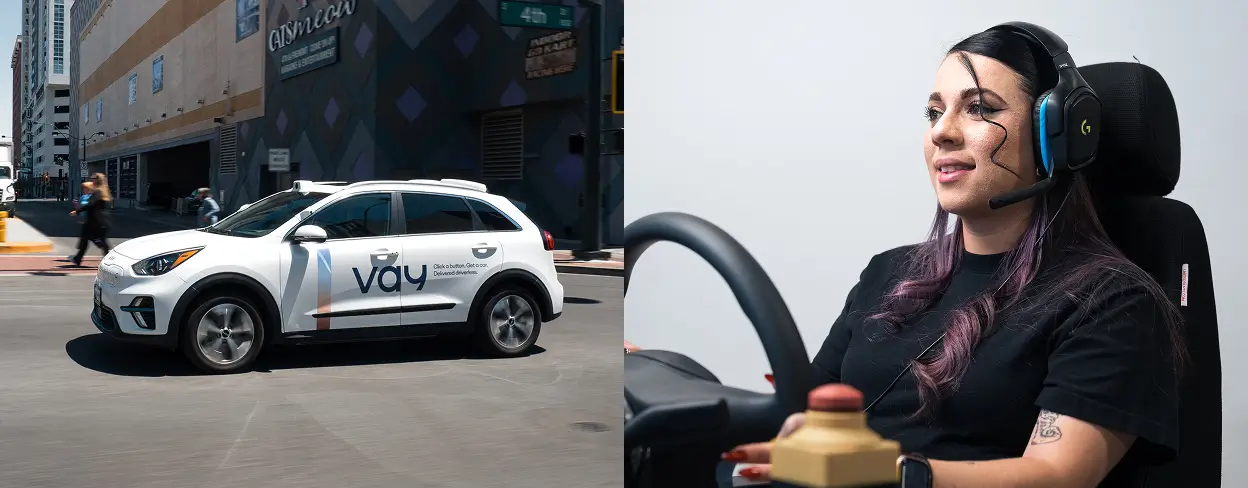
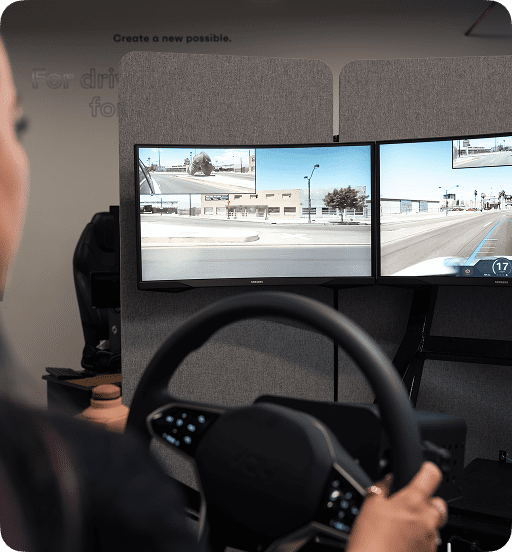
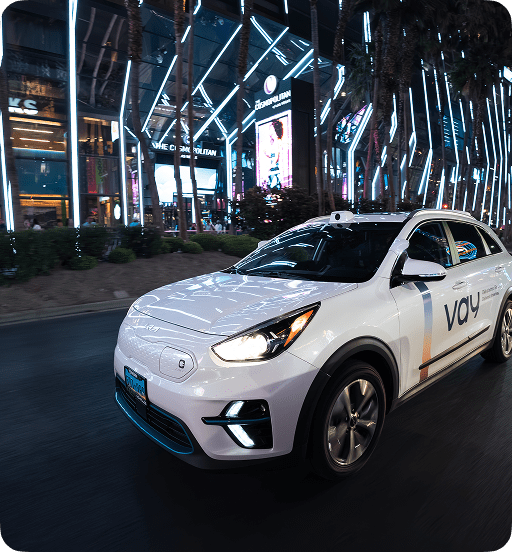
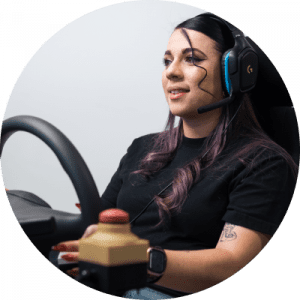
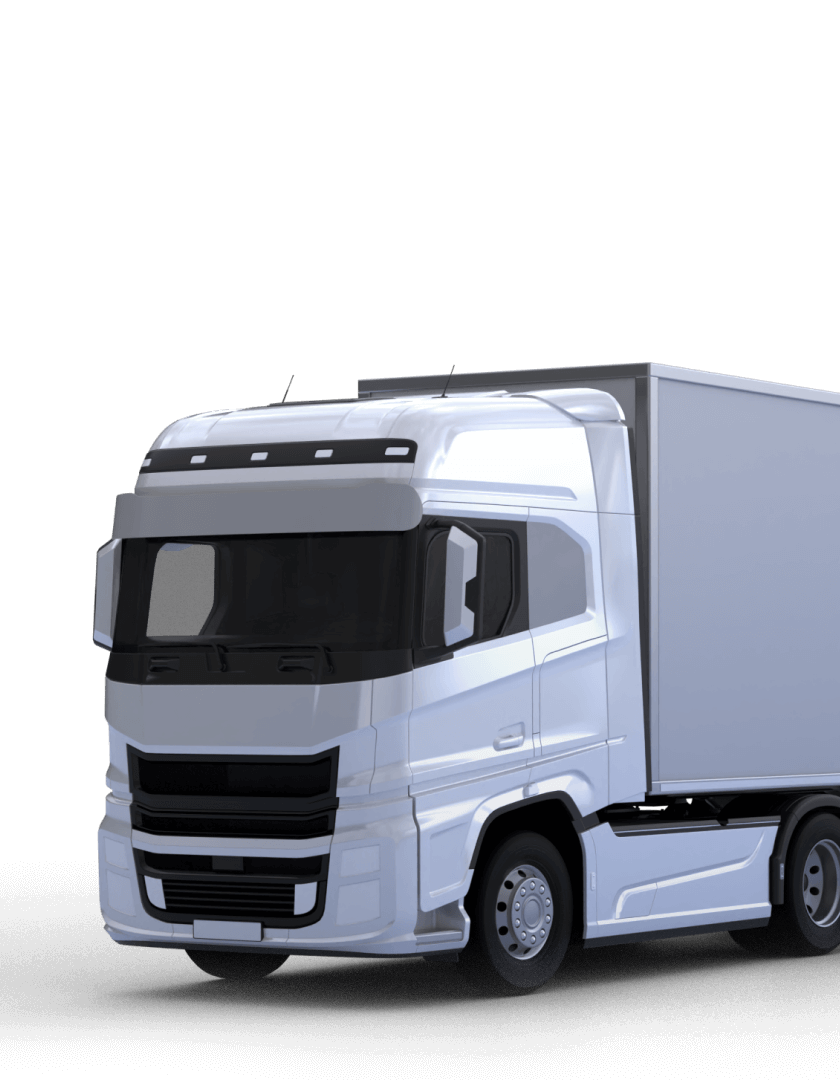
Vay’s proprietary technology enables remote driving. Professionally trained Remote Drivers operate vehicles in real time from a Remote Driving Station equipped with a steering wheel, pedals, and the necessary vehicle controls – developed to meet the highest automotive industry standards. This technology is supporting a range of use cases, from driverless car rental to autonomous trucking and beyond.
How remote driving works
AI-supported Remote Drivers at the heart of Vay’s system
Remote Driving Station
Developed to the highest automotive standards and equipped with a full set of vehicle controls, including a steering wheel, pedals, and auxiliary functions that enable our Remote Drivers to operate vehicles in real time.
Surrounding and in-vehicle sounds, such as emergency vehicles, are captured via microphones and enable a full situational awareness.
Real time data transportation
Our advanced connectivity stack enables live video feeds and sensor data, allowing Remote Drivers to operate vehicles from a distance and navigate city streets, neighborhoods, and pickup locations with precision.
All drivers’ controls are transmitted to the vehicle via an end-to-end encrypted connection, ensuring the highest safety standards throughout operation.
Reliable vehicle operation
Our vehicles are equipped with proprietary hardware that ensures the safe execution of driver commands.
This system is developed in accordance with industry standards (ISO 26262 and ISO/SAE 21434) and ensures reliable and secure operation of our vehicles.
Remote driving allows us to offer driverless services today, while building a safe, flexible foundation for the autonomous mobility of tomorrow.
Our unique approach to Autonomy
While some companies pursue fully autonomous driving that removes humans entirely, we believe in an approach where human decision making meets state of the art AI.
Human
Machine
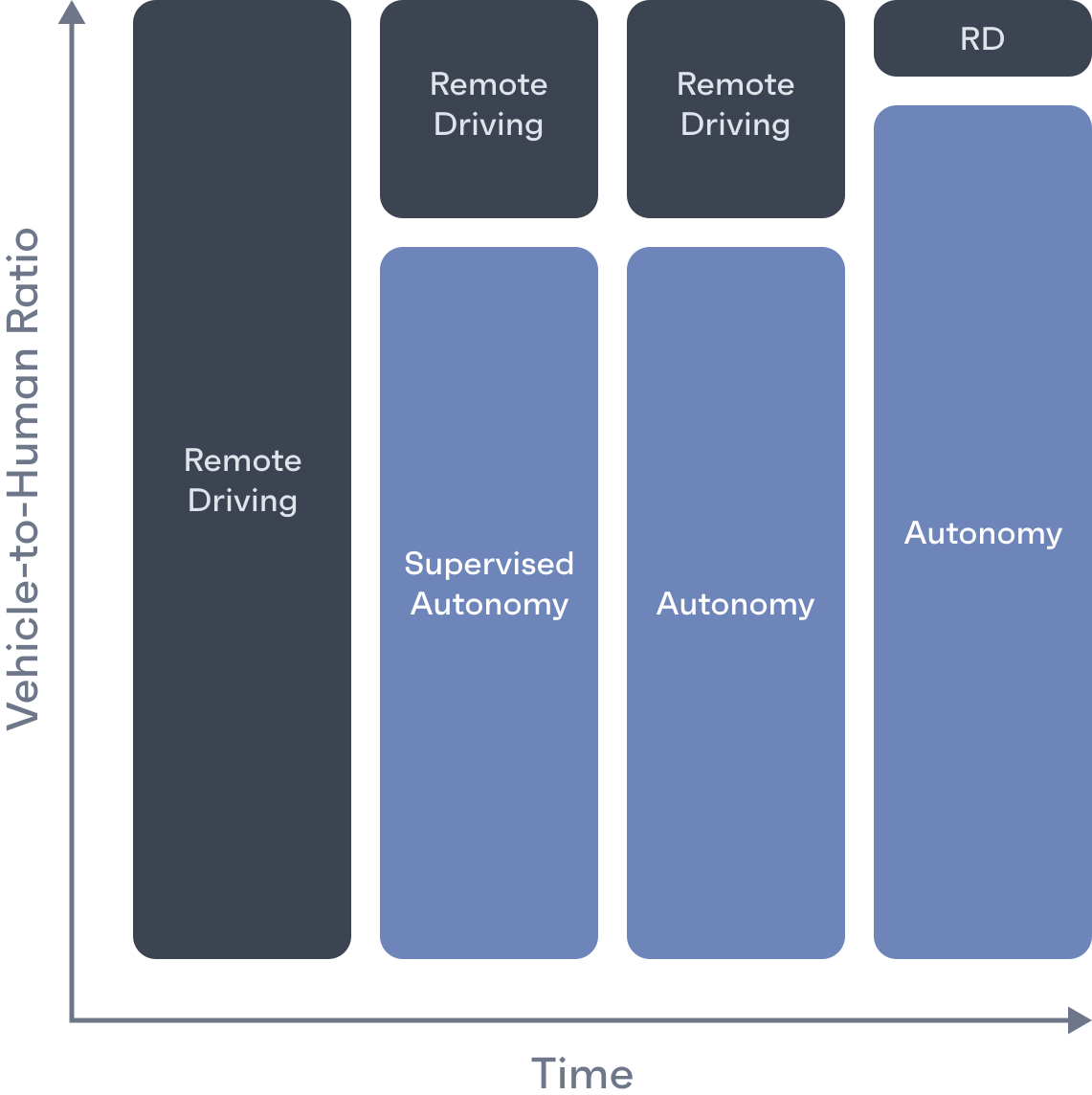
Vay’s unique approach to driverless mobility enables the safe and gradual roll-out of autonomous functions in large fleets. This is only possible because of Vay’s proven remote driving technology. The result is a hybrid system that brings together human judgment, state-of-the-art AI, and machine learning.
Autonomous driving will handle routine driving tasks, such as lane following or stop-and-go traffic, while certified Remote Drivers seamlessly take over in complex situations that autonomy cannot yet manage reliably. This includes crowded intersections and other environments with unpredictable pedestrian or vehicle behavior.
“
Vay has a highly differentiated technology approach towards autonomous driving as it combines Remote Driving with state-of-the-art AI”
Prof. Dr. Sebastian Thrun, Founder of the Google Chauffeur team (now Waymo), Google X and the Stanford Artificial Intelligence Lab.
Why we are uniquely positioned
01
Gradual autonomous roll-out
Vay’s technology enables a gradual rollout of autonomy, making much of autonomous driving achievable today with low vehicle hardware costs and manageable R&D investment. The remaining challenges are significantly more complex and expensive, which is why our approach focuses on step-by-step scaling.
02
Autonomy 2.0 and Embodied AI
Every remote driving session generates high-quality real-world data. This data is continuously used to train and improve Vay’s end-to-end AI driving models, enabling the system to learn, adapt, and progress over time. Remote Drivers can also act as safety drivers, providing reinforcement learning with human feedback (RLHF) to further strengthen performance and safety.
Gradual autonomous roll-out
Remote driving at the core
Vay leverages its remote driving technology as the foundation for data collection and service-model enablement.
Supervised autonomy as a stepping stone
By using the Remote Driver as a safety driver, we can accelerate go-to-market and validate the technology in real commercial environments.
Full autonomy as the end goal
By gradually evolving and expanding our autonomous driving features, we continue closing the gap toward full autonomy while closely evaluating both technological and commercial feasibility.
Autonomy 2.0 and Embodied AI
Camera-based but not camera-only
Vay is taking an E2E driving model approach with redundant perception (Lidar/Radar) to the front.
Free & high quality training data
We leverage training data collected from our customers and Remote Drivers for training end-to-end models.
No need for HD maps
Since Vay is taking E2E driving model approach, there is no need for expensive HD maps.
Solid foundation
HW architectures overlap between remote driving and Autonomy 2.0 stack. Vay has been working on E2E approach since 2021.
Remote driving
Autonomous driving
Benefits
Technical concepts de-risked by commercial deployment & pilots
Very low vehicle hardware costs given our primarily camera-based system
Significantly lower R&D risks & costs than traditional approaches with their rule-based Autonomy 1.0
Short time-to-market given Vay’s gradual rollout of autonomous driving features
Safe by design
Safety is built into every part of Vay’s technology. We use multiple layers of redundancy to ensure safe operation at all times:
Multi-Network Connectivity
Vehicles are connected to multiple cellular networks at once, ensuring stable, real-time control even if one network experiences issues.
Proprietary Hardware
Custom-designed systems in both the Remote Driving Station and the vehicle add extra layers of reliability.
Fail-Safe Protocols
In the rare case of a connection loss or unexpected issue, vehicles are automatically brought to a safe stop.
Our Remote Drivers undergo extensive training and continuous evaluation, ensuring that every trip meets the highest safety standards.