When it comes to driverless mobility, nothing matters more than safety. At Vay, safety is the foundation of everything we build — from our technology design to our daily operations.
How Vay Keeps You Safe
Real-Time Human Oversight
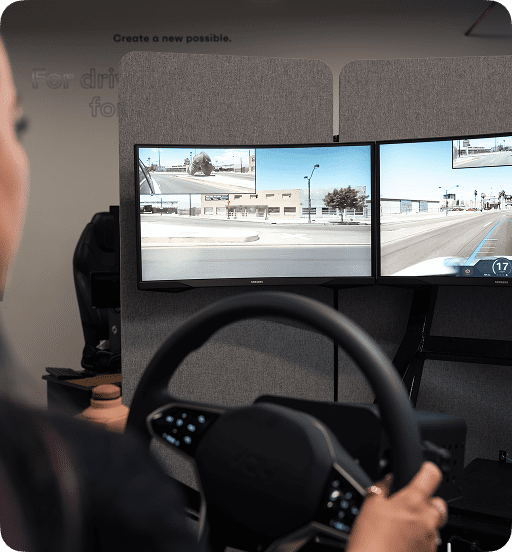
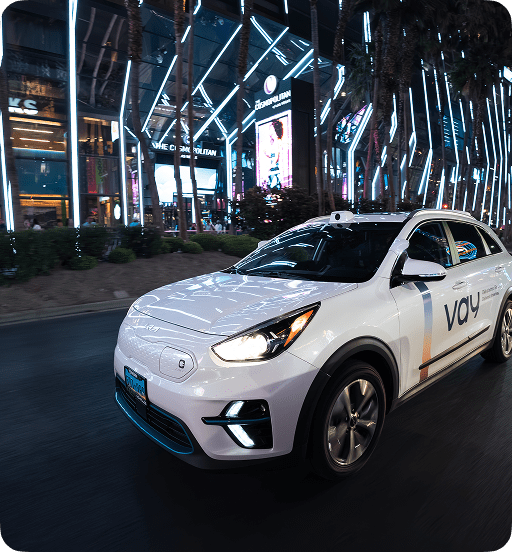
Every Vay vehicle is actively driven by a professionally trained Remote Driver who operates the vehicle in real time from a secure Remote Driving Station. Our Remote Drivers have full control of steering, braking, and acceleration using a complete set of vehicle controls supported by multiple live video and sensor feeds.
Redundant Network Connectivity
Vay’s vehicles are connected to multiple cellular networks at the same time. If one network experiences an issue, others maintain the connection instantly, keeping control stable and continuous.
Fail-Safe Emergency Protocols
In the rare case of a network disruption or abnormal situation, Vay vehicles automatically bring themselves to a safe, controlled stop. This automatic fallback ensures that vehicles never continue driving without active supervision.
Professional Driver Training
Our Remote Drivers undergo rigorous training and ongoing evaluation to meet the highest safety standards. They are continuously monitored and supported by advanced situational awareness systems while driving remotely.
Continuous Monitoring
All remotely driven vehicles are supervised throughout every ride, with real-time system monitoring to detect and respond to any issues immediately.
Vay’s Remote Driving Academy
Professional Remote‑Driving Training Matters
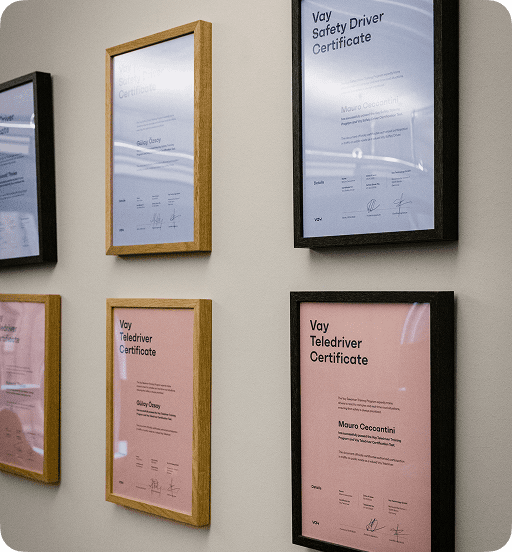
At Vay, remote drivers (teledrivers) don’t just “jump into a chair” — they go through a rigorous, structured program at the Vay Teledrive Academy. Certification from the Academy is a core part of our safety-first philosophy.
Here’s how we ensure every ride meets high safety and performance standards:
Teledrive‑Station Setup
Remote drivers operate vehicles from a specialized station equipped with a real steering wheel, pedals, and other automotive‑grade controls. The car’s surroundings are reconstructed via multiple cameras and sensors, delivering high‑fidelity video and audio (road noise, emergency sirens, etc.) to keep the driver fully aware of traffic conditions.
Comprehensive Multi‑Phase Training
The Academy uses a 4‑module curriculum that includes:
Overview of the teledrive system and safety rules (“Safety First” is our motto)
Safety‑Driver Certification: practice checklists, responsiveness tests, take‑over drills, and required driving hours in safety‑driver mode
Controlled practice on private grounds: emergency maneuvers, braking/swerving drills, “minimum risk maneuver” scenarios.
Public‑street training under supervision, with scenario‑based instruction, ongoing evaluation and safety scoring, culminating in full teledriver certification. Vay+1
Only after completing all four modules — and passing final theory and practical tests — does a driver receive certification to operate on public streets remotely.
Defensive Driving & Safety Culture Built‑In
Our training emphasizes safe, defensive driving behavior. Teledrivers are trained to anticipate hazards, respect traffic laws, and execute controlled responses — even when controlling the vehicle remotely.
Hands-On Validation & Independent Oversight
All our systems comply with automotive safety standards. Every teledrive station and vehicle hardware setup meets rigorous functional‑safety and cybersecurity standards, and independent third‑party safety auditors have validated our system.
Safety at Vay — Certified, Tested & Human‑Backed
Built to Rigorous Safety Standards
Vay’s teledrive system has been independently tested and endorsed by TÜV SÜD, a respected third‑party auditor for automotive functional safety and cybersecurity.
The system is developed in compliance with key industry standards, including ISO 26262 (functional safety for E/E systems) and ISO/SAE 21434 (cybersecurity for road vehicles).
What That Means for Every Ride
Redundant safety architecture: The remote‑driving hardware and software — in both vehicle and station — are built to automotive‑grade safety standards.
Secure connectivity & cybersecurity protections: All data transmission between vehicle and remote station is secured and protected under strict cybersecurity protocols per ISO/SAE 21434.
Fail‑safe design for emergencies: In unlikely events such as network issues or hardware malfunctions, the system is engineered to trigger a safe, controlled stop automatically.
Human + Technology — The Best of Both
Every remote‑driving session is controlled by a real, certified remote driver (“teledriver”) working from a proper driving station with steering wheel, pedals, sensor feeds — not just software.
This hybrid — human judgment + certified, safety‑hardened tech — reduces many risks associated with full autonomy while delivering flexibility and convenience.